
Why Your Hardware Strategy is Quietly Draining Your Profits
5 Surprising Realities of Outsourced IT Management
1. The "Break-Fix" Trap: Why Legacy Procurement is a Growth Killer
For many Small and Medium Enterprises (SMEs), hardware management has long been a reactive, administrative burden. The traditional "break-fix" model—purchasing devices ad-hoc and repairing them only upon failure—has evolved into a significant strategic liability. In today’s distributed workforce, this fragmented approach creates operational friction that directly erodes the bottom line.
The hallmark of a mature enterprise is the transition from asset ownership to service-based utility. Strategic organisations are moving toward Device Lifecycle Management (DLM), treating hardware not as a collection of physical objects, but as a continuous service designed to maximise the productivity of human capital. Crucially, this shift is not just about internal efficiency; SMEs that align their IT strategies with business objectives have seen a 15% increase in customer satisfaction, proving that a robust hardware posture is a direct driver of revenue and external reputation.
2. The "Ghost Asset" Epidemic: The Financial Toll of Visibility Gaps
One of the most pervasive financial drains in SME management is the "visibility vacuum." Without automated tracking, IT asset management (ITAM) becomes a "guessing game" prone to manual entry errors. This leads to the proliferation of "ghost assets"—devices the organisation continues to pay for despite them being idle, lost, or retained by former employees.
In unmanaged environments, these hidden expenses, combined with the costs of downtime, can reach up to 20% of the total cost of ownership (TCO). Professionalised DLM replaces unreliable spreadsheets with real-time tracking and centralised databases. Achieving this level of visibility is no longer merely an administrative preference; it is a core strategic requirement to ensure every pound spent on technology actively contributes to organisational output.
Strategy Note: Visibility is the foundation of fiscal discipline. Identifying and eliminated "ghost assets" often provides the immediate capital required to fund a full-scale digital transformation.
3. The Security Paradox: Why "Letting Go" Actually Tightens Your Defences
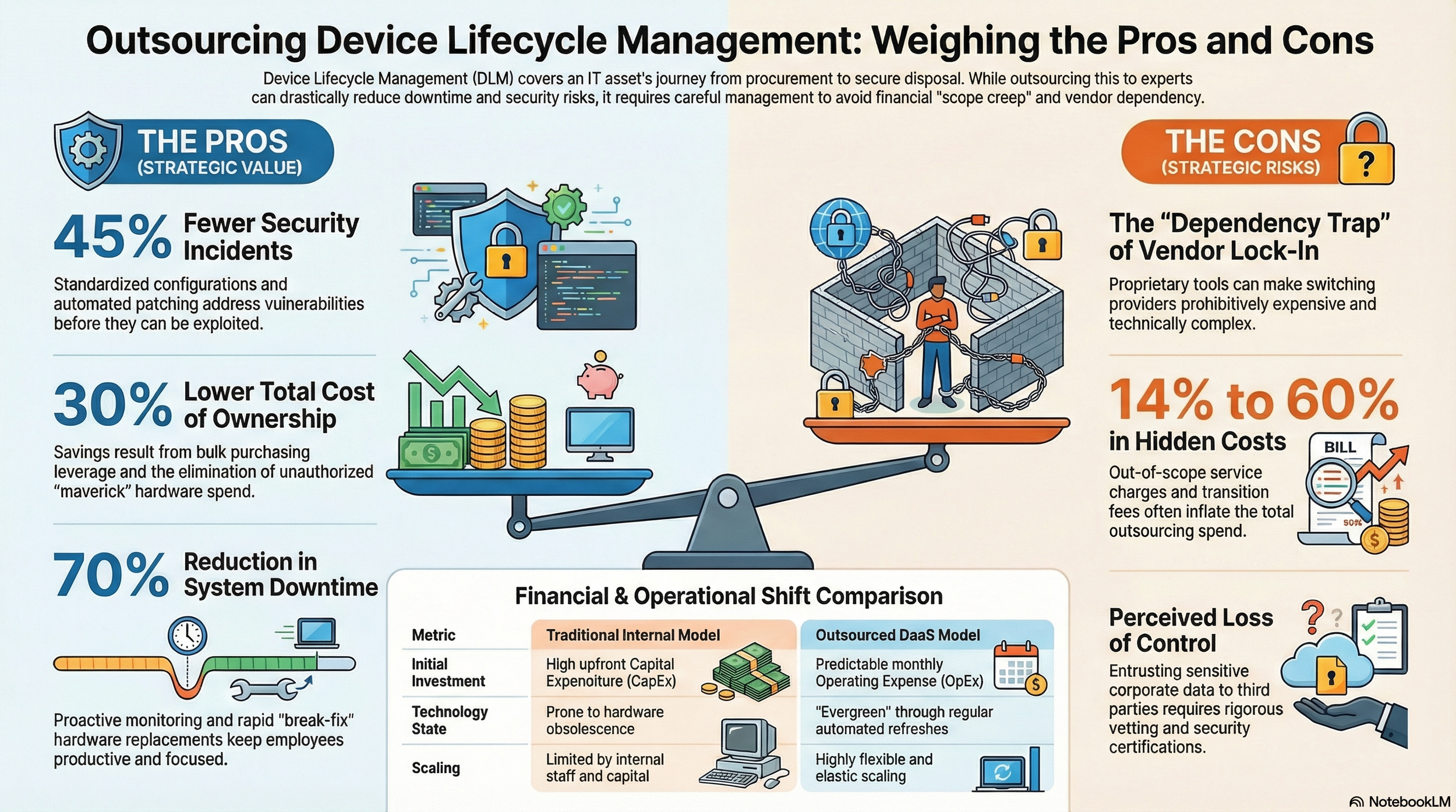
It is a common misconception that keeping hardware management in-house provides greater security. In reality, the data reveals a security paradox: outsourcing DLM typically leads to a 45% reduction in security incidents. This improvement is driven by standardised "hardening," automated patching, and "zero-touch" deployment, ensuring devices are secure before they even reach the user.
However, the most acute risk exists at the end of the lifecycle. Improperly discarded devices account for over 20% of data breaches. This occurs when retired hard drives are left forgotten in storage rooms or devices are sold on the second-hand market without a certified wipe, leaving financial records and intellectual property vulnerable.
Professional providers mitigate this through the "Shared Responsibility" model, utilising the NIST 800-88 standard for data sanitisation. When selecting a partner, business leaders must look for specific certifications—NAID AAA for data destruction, R2v3 for responsible recycling, and ISO 27001 for information security management. These are the only benchmarks that ensure an SME isn't held legally liable for a breach under GDPR or other regulatory frameworks.
4. The DaaS Revolution: Optimising Cash Flow and Tax Efficiency
Traditional procurement requires significant Capital Expenditure (CapEx). A technology refresh for a small office can require an upfront investment of £50,000 to £100,000, tying up capital that could be used for market expansion. Device as a Service (DaaS) revolutionises this by shifting hardware costs to Operational Expenditure (OpEx).
By bundling hardware, software, and support into a single monthly fee, organisations can realise a 30% reduction in TCO. The financial nuance here is critical for the C-suite: while owned equipment must be depreciated over several years—often lagging behind the device's actual utility—a DaaS fee is an immediate, fully tax-deductible business expense. This model ensures the fleet remains "evergreen," avoiding the performance degradation of legacy hardware while preserving cash flow for high-growth initiatives.
5. The "Dependency Trap": Eliminating Maverick Spend
While outsourcing offers substantial benefits, SMEs must navigate the risk of "vendor lock-in" and the hidden 14% to 60% surge in total spend caused by overlooked costs. The primary driver of this inflation is "maverick spend"—unauthorised or non-standard hardware purchases made outside the official procurement process.
To avoid the dependency trap, leaders must move beyond vague agreements. Mitigation requires a clear Statement of Work (SOW) that defines exactly what is "in-scope" and what constitutes a "premium" service. Robust Service Level Agreements (SLAs) should be paired with "termination for convenience" clauses and "transition assistance" mandates. These contractual safeguards ensure that the organisation retains the power to transition its data and workflows if a provider's innovation begins to stagnate.
"Day One" Readiness: IT as a Talent Retention Strategy
Technology friction is a primary driver of reduced employee morale. In a distributed work environment, the hardware experience is the company culture. Outsourced DLM addresses this through "branded delivery," where a pre-configured device arrives at a new hire's home in a professional, company-branded package.
This "zero-touch" shipping removes the technical hurdles that often plague onboarding, turning a logistical task into a powerful talent retention tool. By automating provisioning and proactive monitoring, well-managed DLM can lead to a 70% drop in system downtime. When employees are equipped with high-performance tools from "Day One," they are empowered to focus on high-value tasks rather than troubleshooting, significantly boosting the organisation's overall human capital ROI.
Toward 2026—The Era of Physical AI and Circular IT
As we look toward 2026, the DLM landscape is shifting from reactive support to autonomous resilience. The rise of "Agentic AI" will see AI agents independently managing multi-step workflows, such as resolving software vulnerabilities before a user is even aware of them. Furthermore, we are entering the era of "Physical AI" and "Edge Intelligence"—with 80% of companies expected to implement collaborative, AI-driven physical systems by 2027.
Simultaneously, "Digital Sustainability" will become a core priority. The future of IT lies in the circular economy, where hardware longevity and certified, environmentally responsible recycling are not just "nice to have" but are central to ESG reporting and corporate reputation.
The strategic adoption of managed DLM is ultimately about leverage. It allows an SME to operate with the technological muscle of a global enterprise without the associated headcount. As your organisation prepares for the complexities of the next decade, you must ask: Is your current IT posture a launchpad for your growth, or a tether holding you back?